AI Manufacturing Singapore: 10 Smart Ways AI is Revolutionizing Modern Factories
Manufacturing has always been about speed, precision, and efficiency. But things are changing faster than ever. Today, AI Manufacturing Singapore is helping factories become smarter, safer, and far more productive than they were just a few years ago. From predictive maintenance to intelligent robotics, artificial intelligence is reshaping how products are designed, produced, inspected, and delivered. And honestly… it’s only getting started.
Singapore has positioned itself as one of Asia’s leading innovation hubs, making it the perfect place for manufacturers to adopt advanced technologies. Businesses across electronics, pharmaceuticals, aerospace, food production, and precision engineering are investing heavily in AI Manufacturing Singapore solutions to stay competitive in the global market.
If you’re wondering how artificial intelligence is changing manufacturing in Singapore, here are ten ways it’s making a real difference.
1. Smarter Production Planning
One of the biggest advantages of AI Manufacturing Singapore is intelligent production planning. AI systems analyze thousands of data points in real time, including customer demand, raw material availability, machine performance, and workforce capacity.
Instead of relying on manual forecasting, manufacturers can make faster and more accurate decisions. This reduces production delays, minimizes waste, and improves overall operational efficiency. And that’s something every factory wants.
2. Predictive Maintenance Prevents Costly Downtime
Unexpected machine failures can cost manufacturers thousands—or even millions—of dollars.
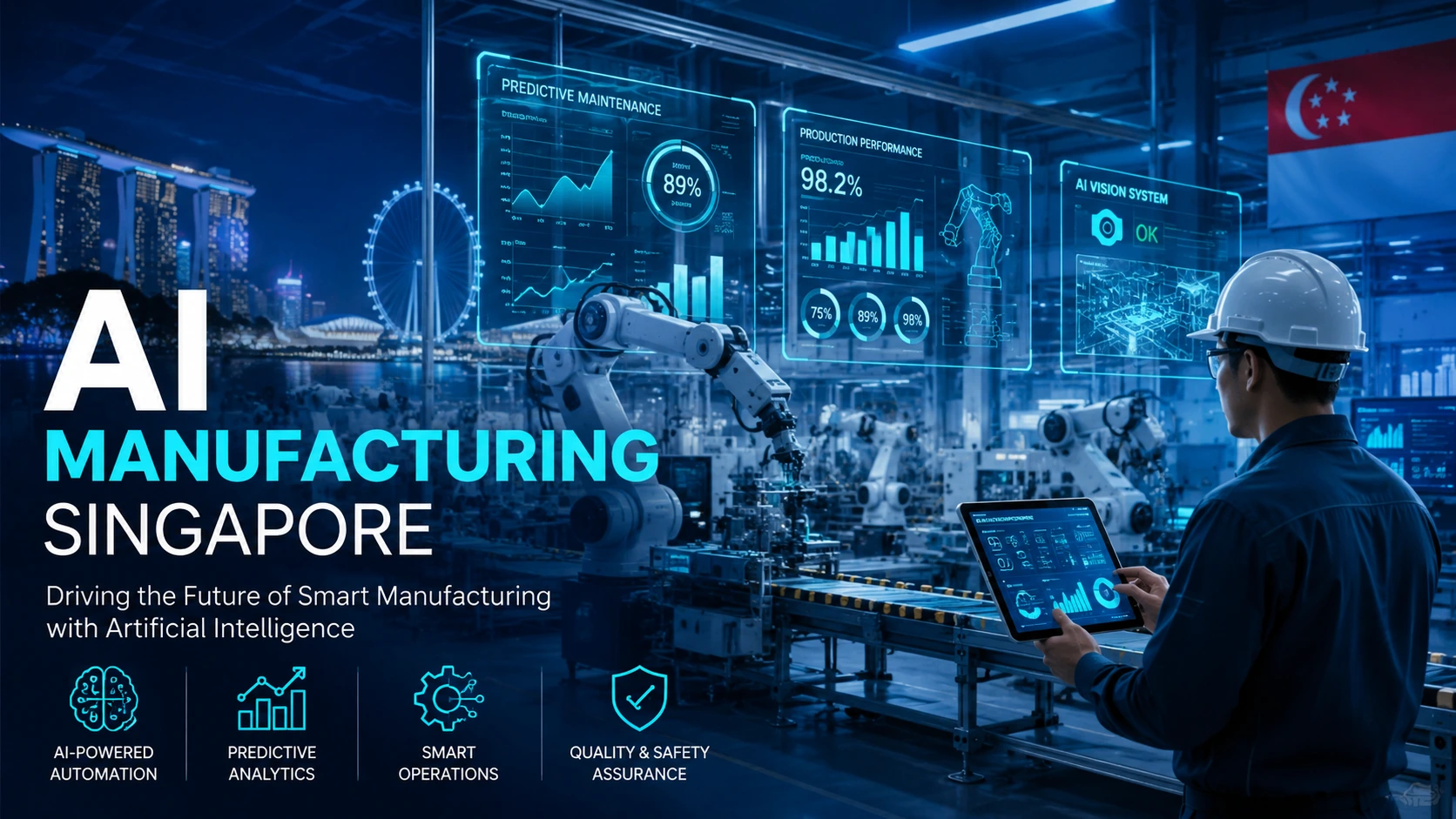
With AI Manufacturing Singapore, sensors continuously monitor equipment health by collecting vibration, temperature, pressure, and performance data. AI algorithms identify warning signs long before a machine actually breaks down.
Maintenance teams can schedule repairs at the right time instead of waiting for expensive failures. The result? Longer equipment life, reduced downtime, and significant cost savings.
3. Better Quality Control Through Computer Vision
Quality inspection has traditionally depended on human workers. While experienced inspectors do an excellent job, even the best people can miss tiny defects after long working hours.
That’s where AI Manufacturing Singapore truly shines.
AI-powered cameras inspect products in real time, detecting scratches, cracks, incorrect measurements, missing parts, or color inconsistencies with incredible accuracy. Products that don’t meet quality standards are automatically removed from the production line before reaching customers.
This improves customer satisfaction while reducing product recalls.
4. Intelligent Robots Improve Factory Efficiency
Robots aren’t new to manufacturing. But AI makes them much smarter.
Instead of repeating the same programmed movement over and over, AI-powered robots can recognize objects, adapt to changing environments, and even collaborate safely with human workers.
Many factories adopting AI Manufacturing Singapore now use collaborative robots—often called cobots—that assist employees with repetitive, heavy, or dangerous tasks. Workers can then focus on higher-value responsibilities requiring creativity and decision-making.
5. Inventory Management Becomes More Accurate
Inventory problems create unnecessary expenses. Too much stock increases storage costs, while too little inventory delays production.
Using AI Manufacturing Singapore, manufacturers can accurately forecast demand, monitor inventory levels, and automate purchasing decisions.
AI analyzes historical sales, seasonal demand, supplier performance, and production schedules to recommend optimal inventory levels. That means fewer shortages and less wasted storage space.
6. Supply Chains Become Smarter
Global supply chains have become increasingly complex.
Delays, shipping disruptions, changing customer demand, and supplier issues can all impact manufacturing operations.
Fortunately, AI Manufacturing Singapore helps businesses predict potential supply chain disruptions before they happen. AI systems evaluate supplier risks, shipping routes, weather conditions, and logistics performance to recommend faster alternatives when necessary.
This allows manufacturers to maintain smoother operations even during uncertain times.
7. Energy Efficiency and Sustainability Improve
Energy costs continue to rise, making sustainability a priority for manufacturers.
With AI Manufacturing Singapore, factories can monitor electricity usage, optimize equipment schedules, and reduce unnecessary energy consumption automatically.
AI identifies machines consuming excessive power, recommends energy-saving adjustments, and even predicts peak electricity demand.
The result is lower operating costs and a smaller environmental footprint. And that’s becoming increasingly important for businesses worldwide.
8. Faster Product Design and Innovation
Developing new products often requires months of testing and redesign.
AI significantly accelerates this process.
Using AI Manufacturing Singapore, engineers can simulate product performance before physical prototypes are even built. AI quickly evaluates different design options, predicts weaknesses, and recommends improvements.
Manufacturers can launch products faster while reducing development costs and improving product quality at the same time.
9. Workplace Safety Gets Stronger
Manufacturing environments involve heavy machinery, hazardous materials, and complex operations.
AI helps improve worker safety in several ways.
Many AI Manufacturing Singapore solutions monitor factory environments through cameras and sensors that detect unsafe behavior, equipment malfunctions, overheating machinery, or restricted-area access.
If a potential hazard is identified, supervisors receive immediate alerts. Early intervention reduces accidents and creates a safer workplace for everyone.
10. Data-Driven Decision Making
Modern factories generate enormous amounts of operational data every day.
Without AI, much of that valuable information goes unused.
Through AI Manufacturing Singapore, manufacturers transform raw data into meaningful business insights. AI dashboards highlight production trends, identify bottlenecks, measure equipment performance, and predict future demand.
Managers can make informed decisions based on facts rather than assumptions, leading to continuous operational improvement.
Why Singapore Is Leading AI Manufacturing
Singapore has built an environment that encourages innovation, technology adoption, and industrial transformation.
Several factors make AI Manufacturing Singapore particularly successful:
- Strong government support for digital transformation.
- Highly skilled engineering and technology workforce.
- World-class manufacturing infrastructure.
- Advanced research institutions and innovation centers.
- Growing investment in Industry 4.0 technologies.
Because of these advantages, Singapore continues attracting manufacturers looking to modernize their operations using artificial intelligence.
Challenges Manufacturers Should Consider
Although AI Manufacturing Singapore offers tremendous benefits, implementation isn’t always simple.
Companies often face challenges such as:
- High initial investment costs.
- Integrating AI with older manufacturing equipment.
- Employee training requirements.
- Data quality and cybersecurity concerns.
- Managing organizational change.
Still, most manufacturers discover that long-term productivity gains and operational savings outweigh these initial challenges.
The Future of AI Manufacturing Singapore
The future looks incredibly promising.
As artificial intelligence becomes more advanced, factories will become increasingly autonomous, connected, and intelligent. Digital twins, autonomous mobile robots, generative AI, machine learning, and advanced predictive analytics will continue transforming industrial operations.
Businesses investing in AI Manufacturing Singapore today are preparing themselves for tomorrow’s highly competitive manufacturing landscape.
It’s no longer just about automation. It’s about building factories that learn, adapt, improve, and evolve continuously.
Conclusion
AI Manufacturing Singapore is changing how modern factories operate—from smarter production planning and predictive maintenance to advanced quality inspection, intelligent robotics, supply chain optimization, workplace safety, and sustainable manufacturing. Companies embracing AI gain better productivity, lower operating costs, improved product quality, and stronger competitiveness in both local and international markets. As technology continues advancing, AI Manufacturing Singapore will play an even bigger role in shaping the future of Industry 4.0. Businesses that begin their AI journey today are positioning themselves for long-term success in an increasingly digital manufacturing world.
Frequently Asked Questions
1. What is AI Manufacturing Singapore?
AI Manufacturing Singapore refers to the use of artificial intelligence technologies in Singapore’s manufacturing sector to improve automation, quality control, predictive maintenance, production planning, and operational efficiency.
2. Which industries benefit from AI Manufacturing Singapore?
Industries including electronics, aerospace, pharmaceuticals, food processing, precision engineering, automotive components, logistics, and semiconductor manufacturing benefit from AI solutions.
3. How does AI reduce manufacturing costs?
AI reduces costs by preventing machine breakdowns, improving production efficiency, reducing waste, optimizing inventory, lowering energy consumption, and improving product quality.
4. Is AI replacing manufacturing workers?
Not entirely. AI automates repetitive and dangerous tasks while allowing employees to focus on supervision, analysis, innovation, maintenance, and higher-value work.
5. Why is Singapore investing heavily in AI manufacturing?
Singapore aims to strengthen its position as a global advanced manufacturing hub by encouraging digital transformation, improving productivity, supporting innovation, and maintaining international competitiveness.